...well, and now for something completely different. The title of course is supposednto remind you of the German king of easy listening, James Last, backed by his orchestra. These guys would turn popular tunes and the occasional original composition into side-long medleys, thus Nonstop Dancing.
This is obviously not that. As a matter of fact, the Non-Stop is definitely not false advertising, as in one swift click you'll get amusement for about two hours and forty minutes. Talk about a long one while he is away, huh? That was not possible without a stack-a-deck back in the days, but I'm sure James Last would be proud.
The whole shebang starts with, obviously, Donna Summer's "Hot Stuff", the disco anthem any gay, straight or non-binary disco lover will recognize as the anthem of the place. Summer did arguably bigger and better stuff, but she will still be remembered, at least here in Europe, mainly for that one. From there, the Nonstop Dancing - Disco Fever mix runs through all the classics from the mid-70s to the mid-80s, from "Rock Your Baby" to "Ring My Bell", from A like ABBA to W like Ward, Anita (not sure there's an X,Y or Z in there, but I might be wrong!).
Disco anthems both cheesy and supercool, now and forever, such as Blondies' immortal "Heart Of Glass". We got Michael Jackson to rock the dancefloor, and Prince, and tons of others. Chances are, if you think of a song from the disco years, it's on here. And even if it's not, tons and tons and hours and hours of retro dancefloor fun are guaranteed, here at OBG's Non Stop Dancing.
So, are ya ready to shimmy? Shake that heini? Blow out those aging hips of yours? Well, here you go...
...and travels in it more than 5700 miles all across Russia. All the while he records the locals he meets or composes electronic music in his compartment. The name of the man is William Rezé a.k.a. Thylacine. The name of the train that will give the resulting album of electronic music its name, is Transsiberian.
I got rid of everything that felt too techno and 'clubby', such as the Moskva track, which I imagine imitates a night out in the capital's nightclubs. Clearly, I was more interested in the ambient parts of the music here, plus the snatches of field recordings of locals Thylacine recorded along the way. The genre is electronica, but especially in this version, you can also file this under (the admittedly sketchy title) world music.
Transsiberian hopefully invites you to a short journey through the Russian backwoods - the original trip from Moscow to Vladivostcock takes six days nowadays - and admire some of its scenery in your mind and some of its sound in your ears...
As all of y'all can imagine, because some of y'all know that the One Buck Guy rolls like that, we are not quite done with Pink Floyd's classic album Wish You Were Here, freshly re-imagined around these parts, yet. What we have here is a little bonus, not from the Floyd, but from the archives of Mojo Magazine, who brought out one of their well-compiled tribute discs to go along with their Pink Floyd cover story (I still remember its slightly sensationalist byline - "'We were a cruel bunch...' sez the Floydsters in the subtitle). It's one of their best, because it actually covers two Pink Floyd discs, the first half Return To The Dark Side Of The Moon covering their 1973 commercial highpoint and Wish You Were Here Again, well, you know.
Surprisingly, I like that second half better than the first one, despite the bands on return being closer to my beloved Americana and indie rock, while Again taps into electronic music, in which I am highly selective. But the run through the five Wish tracks by electronic artist both old (pioneer John Foxx, here with The Maths) and new (Beak>, Malachai, Lia Ices). But, when I say I'm picky, I mean it, so I picked only the choice cuts and moments. Some of the electronic tracks were running a big long and getting repetitive, so I cut these down, and finally ended up turning the entire tribute album into a single mix of around 17 minutes, credited to The Mojo Reboot All-Stars. So, indeed a quick one while I'm away.
If you are absolutely allergic to electronic and beats-based music this is obviously not for you, but if you can groove along to synths and club beats, then by all means check this out. Thesections are the original five compositions in original order (Shine Pt. 1, Welcome, Cigar, Wish, Shine Pt.2), the order of featured artists are: Malachai, Beak>, John Foxx And The Maths, Lia Ices and The Orb), though to start the mix I smuggled a bit of 'Syd's theme' in right at the very beginning.
This is really a quick chaser for the feast that (hopefullly) was the main course of this weekend's alt album. Though a bit out of the wheelhouse from what I usually post here, it might surprise you by sneaking into your musical heart, as it sneakily did with mine. Shine On, You Crazy Tribute Folks...
And the enunciations continue! Stop the press! Hot from the mixing desk! That's Right! Can't Stop Won't Stop!
O.k., enough of this nonsense. But yeah, holiday pastime Bowie mixing is back. It might not have seemed that way, because I spread out my little Bowie mixtapes/megamixes over a year and a half of One Buck Records time, but these were all done in summer 2023, along with the 2.Downtown continuation of the Nathan Adler diaries. And by the end of the summer, I was very well mixed out and Bowie'd out, so I bowed out of Bowie mixing endeavors for a good long while. But while sorting through my music folders a month or so ago, I realized that at the time I had put a bunch of songs aside for two further mixes, including one with a thematic hook that I really wanted to do.
And wouldn't you know it, it's the first week of holidays for me, so I could get to work right away, and Bowie mixtape no. 5, fresh from OBG's mixing desk, is here. And if the name of the mix, Babel, hasn't tipped you off yet - it's the first one with a clearly defined theme: Bowie has dabbled, for most of his career, in recording in different languages to cater to his fans worldwide. No one can accuse Bowie of not being a cunning linguist...
Sometimes he cut a foreign language version because he loved the coutry or the language, as in his two Indonesian-language songs, and sometimes as a career move, such as trying to catch the attention of German schlager listeners in 1967 with a 'German version' (basically one German verse followed by most of the song in English) of "Love You 'Till Tuesday". The same idea is essentially true for the Italian adaptation of "Space Odyssey". Bowie was told that Italians wouldn't get the whole spaceship astronaut thing, so the song was turned into "Ragazzo Solo, Ragazza Sola" - lonely boy, lonely girl. How do you say 'lost in translation' in Italian?
Some of these tracks went nowhere, such as a barely released Spanish version of "Day-In, Day-Out", others were little gifts to fans, such as the Japanese version of "Girls" as Bowie's habitual bonus track for the Japanese album version of Never Let Me Down, or the French and German adaptations of "Heroes" on those countries' versions of the album of the same name. I also went back to his Berlin trilogy for the Turkish-flavored parts of "Yassassin" and the wordless vaguely Eastern-inspired wailing of"Warszawa", as well as the African rhythms of "African Night Flight" and a snatch of Japanese from "It's No Game". The atmosphere of "Abdulmajid" seemed to fit, so that instrumental track got mixed in as well. This is not supposed to be an 'all non-English music of Bowie, ever' thing, but pretty much everything of significance that isn't English should be here.
Here's the tally of Bowie's Babel: 2x German, 2x Italian, 2x Indonesian, 1x Spanish, 1x French, 1x Mandarin, plus the above mentioned bits and bops, for the usual 30 minutes of Bowie.
Bowie the chameleon is one of those easy catchphrases for the genre-hopping artist, but he is also - and definitely - a chameleon in terms of dealing with these foreign languages. I obviously can't speak for how well he pulls off Indonesian, Japanse and Mandarin, but the Spanish sounds okay. He clearly doesn't speak German and manages with phonetics, while Italian seems to come naturally to him. His accent in French is pretty atrocious, though. But these versions are often more than pure gimmicks, and seem to have been important for Bowie, at one stage or another of his career. Now they can all be enjoyed in one easily digestable 30 minute package which I hope you will enjoy. In any language.
So, time to wrap up my "What I did during my summer holidays", here meaning summer holidays 2023, which was mainly spent fidgeting around with bits and pieces of David Bowie, almost literally. I did the first three David Bowie mixtapes, which worked for some, and didn't for others, and I pieced together lots of bits and pieces to make the alternate album/imagined sequel 2. Downtown. So, this is the fourth and last of the mixtapes, entitled Golden Years because I specifically wanted to make a mixtape that covers his commercial heydays of the early to mid-80s.
Bowie's pop star work from 1982 to 1987 is often considered a huge misstep, with Bowie selling out to sell records again and going for the lowest common denominator. Which, to be fair, is true. Let's Dance, from hiring Nile Rodgers as producer and musical director to the song material and arrangements chosen was specifically designed to bring Bowie in the charts again, and it did so, and then some. Tonight was a lazy follow-up with minimal songwriting from Bowie, and Never Let Me Down, which I will still stan for and did an alternate album of, was let down my awful production and some weak songs, though it's better than general opinion has it. But, yeah, it's a difficult period to love unconditionally, only bested by the folowing Tin Machine-era for least loved Bowie.
But not all was bad, and maybe Golden Years will remind you of that. Or not, but it'll valiantly try. As usual, the idea was to not use the original hit versions, but use lesser known versions of the songs, so you'll get, among other things, live versions of "Heroes", "Fame" and "China Girl", the TOKiMONSTA remix of "Golden Years", the dub mix of "Absolute Beginners", the vocal dance mix of "Tonight" and another snatch of the Moonage Daydream version of "Modern Love", all of course in longer or shorter snippets, as per usual. And there are a couple of other little surprises, which I will let you discover for yourself, if you feel so inclined.
Golden Years lets the blond-dyed David Bowie of the 80's (and a bit of the 70s and 90s) back in your life, if only for a short while (literally, as this is the shortest of the four mixes). So, let him in, and see if you can't swing a little bit with the thin white duke platin-blonde popster...
Et maintenant pour quelque chose complètement différente, comme disait les Monty Python.
Hey there, possibly francophile One Buck Head! Do you remember "Rockollection" or have ever heard of it? No? Well, you haven't missed much. "Rockollection" is a 1977 single by French artist Laurent Voulzy that does what Bob Seger was doing in the U.S. - selling baby boomers their first big wave of nostalgia. The song runs down all the things from your youth and teenage years you become nostalgic about: the cute girl with the poneytail, the summer camp, the motorbike you had, that kind of thing. And of course the music that was the soundtrack of your youth. Maybe Voulzy had seen "American Graffiti"? Anyway, in between the verses Voulzy injected ever changing choruses the refrains of known English-language classic rock and pop songs from the 1960s: "The Locomotion", "A Hard Day's Night", "I Get Around", "(I Can't Get No) Satisfaction", "Gloria" (the full album version adds another four). "Rockollection" is a piece of kitsch and sentimental pap and an easy way to get the audience on your side - having the easiest and most memorable choruses of songs that even folks with very limited English knowledge - and at that time that was presumably about 99% of the French population - could yell out in front of a radio. "Rockollection" was a pure crowd pleaser - and crowd pleasing it did. There's even an English language version. Take it away, Laurent:
What does that have to do with our One Buck Record of the day? Absolutely nothing! How's that for a surprise. Basically, I just stole the name for the mixtape that makes up today's offering: La Vraie Rockollection. Because unlike Voulzy's nostalgia trip for the 60's, this is a different kind of nostalgia trip, taking you back to the mid-80s to late 90s. Meaning my youth, but also the wife's. I didn't know any of these songs before moving to the country of frog, snail and smelly cheese-eaters. My wife, though? Knows all of the songs, has most artists in her not particularly extensive CD collection.
Télephone, Les Negresses Vertes, Les Rita Mitsouko, Matmatah, Louise Attaque, Noir Désir - you name me a big name from the rock-oriented charts, it's sure to be on here. And then of course there is Jean-Jacques Goldman ("Quand La Musique Est Bonne"). How unbelievable is it that the country's biggest (and internationally most unknown) superstar is called Jean-Jacques, French name to end all French names? Before arriving here In France I had never heard of this guy, but he is essentially France's Phil Collins and Bruce Springsteen rolled into one. He is regularly voted "Most popular French personality", with the gallic people characteristically forgiving of the fact that after retirement Goldman was suggardaddying it with a teenage bride, seemingly a French sport for a certain type of well-known star (see: Halliday, Johnny or Besson, Luc). A little icky, JJ, but obviously not enough to put a dent into most popular star status.
Is it my mullet...or is it my body?
The other monster group on here, if only by how long they lasted, is Indochine, represented here by two songs, including opener "Bob Morane". Indochine started out as 'The French Depeche Mode' (and actually supporting them during early French tours), but much like their role model they grew out of pure synth pop, incorporating rock elements and becoming elder statesmen of French popular music. Selling in excess of 13 million records, they are the French band with the most record sales in the world. They also broke the attendance record in France's biggest stadium, filling the Stade de France with 97 036 spectators and are of course runner-up to Jean-Jacques Goldman as the second most popular stars of the country.
Rock band Noir Désir became arguable France's biggest band in the 90s, but are of course and unfortunately known for one thing: Lead singer and songwriter Bertrand Cantat beating his then girlfriend, French actress Marie Trintignant to death in a drunken rage and going to prison for three years (having been condemned to eigth) in the middle. The bans reformed afterwards but after Canta's wife comitted suicide and Cantat then denied any wrongdoings in both deaths while claiming that his bandmates profited from his notoriety, guitar player Serge Teyssot-Gay quit the band, quickly followed by the rest of the group.
Psycho Killer...qu'est ce que c'est? - you better run run run run run run away...
I haven't even mentioned Télephone, the biggest French rock band of the late 70s and early 80s, until the usual proverbial musical differences did them in! Or Brittany's Matmatah who proudly incorporated traditional instrumentation from the region - meaning Celtic influences - into their music. The La Vraie Rockollection megamix ends with the group led by the impeccably named Benny Bonvoisin (Benny The-Good-Neighbour, and it's his real name!) and his hard rock troupe Trust with their signature song "Antisocial". Bennie and the Boys became fast friends with AC/DC when meeting them at the same record studio while recording their debut album. Bernie's political, critical lyrics show a real alignment with the punk rock of the era.
So, place à la musique, n'est-ce pas, around 45 minutes of French rock and rock-ish classics from the 80s and the 90s, for francophile rockers and those that want to become ones...
And of course, Mr. David Jones is not the one to deny such an opportunity. And why would he? (Also, he's dead and I don't know him personally, but that's beside the point). So, part three of my "What I did during my summer vacation 2023" series, which was pretty much all Bowie all the time. The first two Bowie mixtapes you can find here and here, and - oh boy - is it really more than nine months since the last one? There's one more after today's edition, and the last part of my Bowie-related summer holiday mixing sessions was the never esisting sequel to art pop extravaganza 1. Outside, dashingly titled 2. Downtown. But yeah, enough with the chit chat, off to business.
At the heart of Where Are We Now? was the idea to marry Buddha of Suburbia's outstanding (almost) instrumental "The Mysteries" to his vocals from late period masterpiece "Where Are We Now". From there I expanded to the usual 30 minutes, and as before I prioritized numbers from the Moonage Daydream movie as well as unusual versions of remixes to the original versions, so that even hardened Bowie fans would have things to discover or re-discover during this. So, "Shopping For Girls", one of the few successful Tim Machine numbers, is here in the attractive, acoustic, slide guitar-based arrangement Bowie used for his 50th birthday, "Panic In Detroit" is the remake he cut in 1979 and "Seven" is here in its demo version rather than the album or single cut.
The original idea was to focus on his artier songs, but I quickly changed course, making place for fan faves like "Life On Mars?"and "Changes" and ravers "Holy Holy", fearing that otherwise the mix would become somewhat of a slog to get through. Now we not only have a solidly entertaining thirty minute trip through Bowie's career, but also something that has enough dynamism and variety to hold up to repeat listens. It also makes use of Bowie's own adventurism: Around the half-time mark we have a mash up that Bowie himself commissioned in the mid-2000s when these first became popular, "Rebel Never Gets Old". And finally, I decided to build the last third around Bowie's and Reeves Gabrels' pre-Tin Machine re-imagining of "Look Back In Anger", an impressive (if divisive among fans) track. And, ironically, Where Are We Now? has way more "Moonage Daydream" than Moonage Daydream!
Listening back to this at least a year after last listening to it, I was pleasantly surprised. I think this runs really well and I hope you'll agree...
Ah, Kate Bush, the elder stateswoman of art pop. How satisfying it was two years ago to see her belatedly get to number one with "Running Up That Hill", undoubtedly one of her best songs. Sure, it needed Stranger Things, but quality is quality, and considering what else is floating around in the charts these days...
Bush worked steadily, if slowly, throughout the late 70s and 80s and into the early 90s, but then - poof - she was gone. 1993's The Red Shoes, arguably her most streamlined and conservative pop effort, including guest spots for Eric Clapton and Prince, wasn't the start of her second career phase as some sort of adult contemporary pop star. A planned one year hiatus turned into twelve, allowing Bush to start a family and otherwise drop out of the public eye entirely.
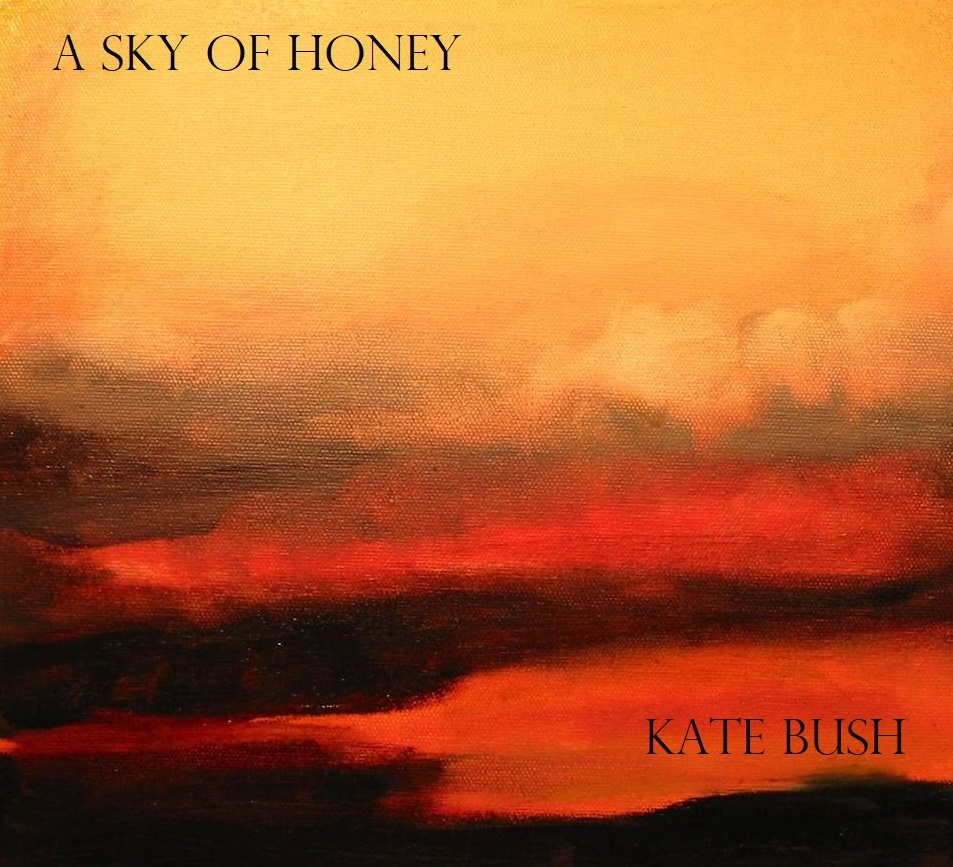
And then, without warning, she was back. Aerial, in 2005. A double album, with pretentious titles, just like in the old days. Disc 1, A Sea of Honey, was fine, a collection of art pop songs in different style. But for me the real treasure was Disc 2, A Sky Of Honey. A conceptual piece, it is designed to show 24 hours passing by. It has a narrator and recurring characters. It is, in short, Kate Bush's fully fledged prog album. But its status as, essentially, a bonus disc of sorts makes me think that A Sky Of Honey is both underappreciated and simply not heard enough. Considering its structure as a song cycle, A Sky Of Honey makes no sense as individual pieces, so I decided to edit its songs into one album-long track. I kept the parts mostly untouched, shortening and tightening up some of the track transitions, but that's about it. I want the pieces (or now, the piece) to speak for itself.
There is one (well, one and a half) notable exception: Bush's witchy voice has its raison d'être, and can and does get used effectively, but I didn't need to hear it at this long end's journey into the night, so I did bring in my scissorhands right for the end. I found some of the noisy (and, uh, witchy) excesses of "Nocturn" and "Aerial" too much. Three quarters of A Sky Of Honey are pastoral and lush, so the intrusion of a noisier sound right at the end wasn't my cup of tea. It broke the spell of what came before a little bit, so those pieces got shortened. You will still get the gist of Bush's night's end, but in a slightly gentler way.
So, I need about 36 uninterupted minutes of your time to get lost in A Sky Of Honey. Its a trip well worth taking...
If you have never seen Peter Fonda's The Hired Hand, you should probably rectify that omission. It is a fabulous and unique movie, part of the wave of revisionist Westerns that the New Hollywood brought with them, and yet it's own thing entirely apart. It was directed by one of the spearheads of the New Hollywood, coming freshly off Easy Rider, with a blank cheque for his directing debut, yet it has no signs of hipness or appealing easily to the counter culture the way Rider did. Of course it was a disaster to market, bombed and got taken out of cinemas almost immediately. Its failure alienated Peter Fonda from the Hollywood industry for years. It is a Western unlike any other.
Part of its otherness, even within the genre, is the screenplay by Scot author Alan Sharp. Here, men aren't stoic and stay cool in every situation, the stereotype of the Westerner. When men die here, they wince and are afraid, they cry for their mother, or for a friend. "Hold me, Arch." Women aren't just there to support the men of action around them, they are their own boss. The decide what they do with their lives, with their bodies. When Peter's sister Jane watched the film, she told him that he'd made a feminist film. She isn't entirely wrong.
Another part of its otherness is the outstanding work by DP Vilmos Zsigmond and editor Frank Mazzola. Especially in the first half of the movie - more impressionistic and less plot/dialogue-heavy - they create a Western unlike any other. Zsigmond's outstanding filmography - often only using natural light - was amplified by Mazzola's editing, with freeze frames and impositions, to create painterly tableaus that you haven't seen like this. Fonda wanted to make a film about the elements, and it shows, even if he had to be convinced at first to keep the stunning sequencees Mazzola created out of Zsigmond's fantastic images.
And the last part of the otherness is Bruce Langhorne's music score, for which he played dozens of instruments, including unexpected ones like Sitar or flute. A true one man band. A review described his music as "both earthy and ethereal", which is right on the money. The earthy part are the choice of instruments, inspired by what instruments really were played at the time. The ethereal part is the music itself, which is extrememy beautiful, but also ghostly and otherworldly at times, perfectly supporting the slightly off-kilter atmosphere of The Hired Hand, especially in genre terms.
It's maybe fitting that Bruce Langhorne himself is somewhat of a hired hand - a studio musician who would lend his acoustic fingerpicking skills to many a folk artist from the 1960s, most prominently Bob Dylan. It is by established by the man himself that the title character of "Mr. Tambourine Man" is Langhorne himself. The Bobster himself said "'Mr. Tambourine Man,' I think, was inspired by Bruce Langhorne. Bruce was playing guitar with me on a bunch of the early records. On one session, (producer)Tom Wilson had asked him to play tambourine. And he had this gigantic tambourine. It was like, really big. It was as big as a wagon-wheel. He was playing, and this vision of him playing this tambourine just stuck in my mind. He was one of those characters...he was like that. I don't know if I've ever told him that." Like the inscrutable title character of Dylan's tale, Langhorne jingle-jangled, and played, and continued playing, never drawing much attention to himself. A true hired hand. He never made a solo record until 2011, an album that never came out on a label. It was called Mr. Tambourine Man and featured Langhorne and his big-ass tambourine the size of a wagon wheel.
The Hired Hand, the movie is a total mood piece, and so is The Hired Hand, the music score. In keeping with that I worked the score into a single long piece, a sort of mixtape that keeps all the magical parts of Langhorne's score, mostly in chronological order, and eliminates a couple of minutes of more incidental music.The original score wasn't very long to begin with, around 25 minutes, and you'll get a little more than 17 minutes of that here. Just the best for the readers of One Buck Records, same as it ever was.
Now that is a grown man's tambourine right there...
Let Langhorne whisk you away for a magical quarter of an hour, then go and find out how you can see The Hired Hand. You will regret neither.
When I finished the first of my David Bowie mixtapes (see September 2023), based on the alternative mixes from the Moonage Daydream film, I was generally happy with the results, but there was definitely room for improvement. It was, in many ways, a test run. And a test run includes oversights. Cleaning up the mess (closing and filing all tracks used and in the running for the mix) I realized that I hadn't used one track I really liked: the Moonage Daydream mix of "The Mysteries" (complete with a snatch of "Absolute Beginners"), which I felt was perfect as a sort of overture for a mix. This could mean only one thing: sequel!
So here is the second David Bowie mixtape, and my personal favorite. one justifiable criticism of the first mix was the length of the songs used, which didn't work for some readers. Some of this was down to the length of the original song pieces (some more snippets than songs), but I aligned behind that type of length on that mix. This new mix, Sounds And Visions, has, I feel, a bit more breathing room. It's definitely a more relaxed, and maybe more relaxing, listen. Songs generally run a little longer, some to full length or almost, and there's a more balanced feel to this one. Some song bits are still relatively short, on purpose, in a "hey, remember this cool song?" vibe. And, like the first mix, the emphasis was on hearing Bowie not quite like you and I know and love him, so I heavily leaned on alternative versions (like the acoustic version of "The Man Who Sold The World" he cut for his 50th birthday special), a live cut ("Sons Of The Silent Age, featuring Peter Frampton on co-lead vocals), a mash-up ("Rebel Never Gets Old", commissioned and released by the man himself), a demo ("Let's Dance"), deep cuts and remixes to give this a slightly different feel once again. Cover art borrowed from a gentleman named Ahmad Nusyirwan.
So yeah, overall I'm quite proud of Sounds And Visions which came out like I wanted it to. Tell me what you think in the comments, will ya?
Without further ado, here's Bowie and his Sounds And Visions.
I didn't have an idea who Winston Francis was when I fished the basis of today's little mix out of the bargain bin. The cover art sure as hell didn't help, the whole thing looked like a bootleg. And yet, the record store of my choice really wanted to get rid of their overstock of unwanted discs, throwing out 15 for ten bucks. So, when I had found eight or nine that interested me I took a flyer on the rest of them, including the Feel Good All Over - The Medley Album of Mr. Winston. It is exactly what it says it is, Winston singing his way through over thirty song snippets, but over the course of an hour, the approach of having Winston sing over a barely changing rhythm gets a little tiresome, So, some sugery was in order. Here's about a third of the medley, having Francis sing his way through oldies but goodies like "Midnight Hour", "For The Good Times", Raindrops Keep Fallin' On My Head", "Can't Help Falling In Love", "Red Red Wine" and "Wonderful World". First rate karaoke? Maybe. But as a little palate cleanser while the days get shorter, darker and rainier around here, here's some sunshine reggae from good ol' Mr. Fix-It...
I would have thought that his untimely death in 2016 would've cemented David Bowie as one of the all-time greats, but it seems that opinions may still vary quite a bit. Some still see him only as the red-haired make-up wearing glam rock king of the Ziggy years, others remember him with shudders from his beach-blond Let's Dance period. Both are of course surrounded by other Bowie avatars - The Thin White Duke, the Ashes to Ashes harlequin etc. What is undeniable is that Bowie was more than just Ziggy, more than the Top of the Pops star. Bowie did vaudeville, British invasion r'n'b, folk and folk rock, hard rock, glam rock, Philly soul, art rock, mainstream pop, hard rock again, dance pop, art rock again, jungle & drum'n'bass, retro rock and finally a jazz-inspired record. That's an impressive list of musical exploration, whichever way you slice it. Sure, Bowie had times where he was chasing after the bus, rather than driving it. But I would say it's still fair to have him at at least 50% trendsetter, 50% trendhopper. His interest in whatever music caught his fancy at any given time could see him zig where people wanted him to zag, apart from an unfortunate period in the 80s. And hey, even from that time there are things to salvage (in later posts here at One Buck Records).
I haven't seen Moonage Daydream, the archival documentary directed by Brett Morgen, though I've picked up the movie in the local library, just waiting to be watched whenever I find the time. But the soundtrack to the project caught my eye, mainly because besides a bevy of live music there was a bunch of music presented in alternative and remixed form, some of it featuring gentle mash ups of several compositions. A lot of the more exotic tracks however, were essentially snippets, sometimes only a couple of seconds long. From there was born the idea of a single long track, a sort of megamix that would reunite the most interesting moments of this project. A lot of the music here is from the mid- to late 70s, so if you enjoy Bowie's "Berlin period", then you will probably find lots to like in it. I know I did. It was a lot of fun to revisit these songs with a twist. I hope the same will be true for you. And you might thus not even notice that the song that gave the film its title is missing from the line up! So, there's no freaking out here, but maybe something else...bliss out in a moonage daydream, oh yeah!